Writing as a return to the self
L'Amour et les ForêtsWriting as a return to the self is the recovery of inward life that Bénédicte Ombredanne experiences during her stay at Sainte-Blandine. In a life narrowed by her husband’s monitoring and demands, writing gives her a protected activity through which memory, sensation, and language become her own again. Its importance lies not simply in preserving an episode from the past, but in helping her rediscover herself as a singular person with a mind and voice capable of making something new.
A private practice in a place of refuge
After taking an overdose of Xanax, Bénédicte is admitted to Sainte-Blandine. She is guarded in her conversations with the psychiatrist, unwilling to disclose what led her to take the tablets. She fears that fuller disclosure would turn her circumstances into a marital problem to be managed, bring her husband into clinical discussions, and end the quiet she has found in the clinic. That quiet matters because she has begun to feel a desire for life and the possibility of beginning again.
Her silence is therefore not simply an absence of thought. It protects a fragile inward movement that she does not yet trust others to understand. At the clinic she can be alone in her room, at a distance from the questioning and surveillance that shape life at home. Her husband knows her schedule and expects to be able to reach her; she has described choosing to disappear from his awareness for several hours as an act whose consequences she will have to bear. During the later, repeated interrogations about her afternoon with Christian, even the memory of that event is subjected to his demands. Writing offers a different relation to the past: she can approach it on her own terms rather than answer another person’s questions.
From ordinary paper to a record of memory
At first, Bénédicte does not ask her husband to bring her a notebook. She anticipates that he would question why she wanted it, what she planned to write, and for whom; she also fears he might later demand to read it or search for it in her absence. Because writing could become another occasion for suspicion and renewed harassment, she keeps the project to herself. Instead, she asks the psychiatrist for paper and a pencil. A secretary soon brings her a stack of sheets and a mechanical pencil, ordinary supplies that acquire unusual value because they make the work possible without involving her husband.
Bénédicte intends to record the afternoon of March 9 with Christian as fully as memory allows. Her plan includes their conversation, the house and objects she noticed there, and the changing sensations associated with the encounter. She wants to preserve details rather than let the experience remain only a memory that can be summoned, distorted, or interrogated by someone else. The writing does not undo what has happened, nor does it resolve the danger of her domestic situation. It does give her a form in which she can order what she remembers and decide what deserves attention.
The act of making a record soon exceeds the task of documenting a single day. As the pages accumulate, Bénédicte rereads them and experiences them as a mirror in which she can recognize herself as distinct and estimable. The value she recovers is not dependent on another person’s approval: it emerges through her encounter with her own words. Writing becomes a way to notice and cultivate an inner life that years of resignation had left neglected.
Language, body, and renewed agency
Bénédicte experiences writing as an embodied activity, linked to the sensations she is trying to understand rather than separated from them. Her account attends to how remembered feeling changes, where it is registered, and how one sensation gives way to another. In the clinic’s solitude, she describes words and phrases arriving as she writes, allowing her to shape an account from what she notices within herself. The return to language is also a return to authorship: she is no longer only the object of her husband’s interpretations or the subject of an interrogation, but the maker of a record.
She does not mistake this recovery for a completed transformation. She recognizes that her pages repeat themselves and may need editing, yet she accepts the excess as evidence that the desire to write has returned. After a long period in which she had remained fixed in a life of teaching and resignation, the movement of composition lets her feel that she can change. The text presents this not as a neat cure but as an uneven revival: sleep, solitude, memory, bodily awareness, and language meet in a practice that gives her access to a previously neglected sense of possibility.
An earlier refuge, recovered
The nights at Sainte-Blandine recall Bénédicte’s adolescence, when she studied toward admission to the École normale supérieure under the pressure of her father’s expectations. After the household had gone to sleep, she would leave the role of the diligent student and read books she had chosen for herself. She made a low, enclosed shelter from her sheets and read by a small lamp inherited from her grandmother, taking care not to be discovered and criticized for losing sleep. Those private reading hours had allowed her to feel inwardly free and alive even while her daytime work was governed by performance and ambition.
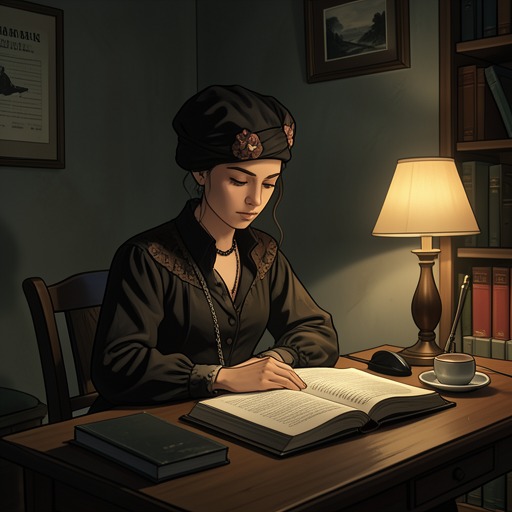
At the clinic, she again rises at night while the building is quiet, but now to write. The parallel makes her recovery more than a return to youthful literary pleasure: it reconnects her with an earlier capacity to distinguish her own desires from roles imposed by others. The refuge has changed from a makeshift reading place under the sheets to a room in a clinic, and reading has become writing, but both practices create time for an unobserved self. Through that continuity, the narrative presents writing as a modest yet consequential form of self-return: a way for Bénédicte to find herself in language while the conditions of her life remain unresolved.